Remove Food and Water Attractants Coyotes Look For
By CoyoteBytes Editorial TeamChecked by CoyoteBytes Editorial TeamReview date First published Filed under Yard & Home
Food is the main reason coyotes become comfortable around homes. The Arizona Game and Fish Department (AZGFD) says all potential food sources must be removed, including pet food, garbage and fruit, and that even one regular source on a block keeps coyotes active in the whole neighborhood. UC IPM also advises eliminating available water sources. Feeding wildlife is unlawful in Pima County.
Part of our guide: Manage and Protect Arizona Homes from Urban Coyotes
This is general information, not veterinary, medical or legal advice. For an injured or aggressive animal, a bite, a pet attack or a suspected rabies exposure, call your doctor, your vet, local animal control, or the Arizona Game and Fish Department (AZGFD).
Reviewed by the editorial desk against the cited sources. The desk holds no wildlife-biology, veterinary or medical credential.
Coyotes come to yards because yards offer food. This page is a close-up of one part of our yard and home coyote management guide: what to remove, and why it matters. It pairs with the coyote-proof yard checklist and with fencing. Child and pet safety, the main reasons people care, are covered in our guide to protecting pets and children from coyotes.
Why food is the key
AZGFD says coyotes are naturally curious but usually timid animals that run away if challenged. They become a risk once they grow comfortable around humans, usually because of feeding or indifference, and then they see people, yards and pets as food sources and safe havens. The agency’s advice is to discourage coyotes from feeling comfortable by never intentionally feeding them and eliminating attractants, including pet food, from the yard.
AZGFD also says that if there is a regular coyote food source in one yard on your block, coyotes will be active throughout the neighborhood, and that all potential food sources must be removed. In other words, your yard does not stand alone. A neighbor’s open pet bowl or unsecured trash affects your pets too, which is why AZGFD calls a unified neighborhood effort crucial.
AZGFD lists what coyotes eat: whatever is available, including seeds, dates and other fruit, dead animals, rodents, rabbits, garbage, pet food, house cats and small dogs. Anything on that list that you provide on purpose or by accident is an attractant.
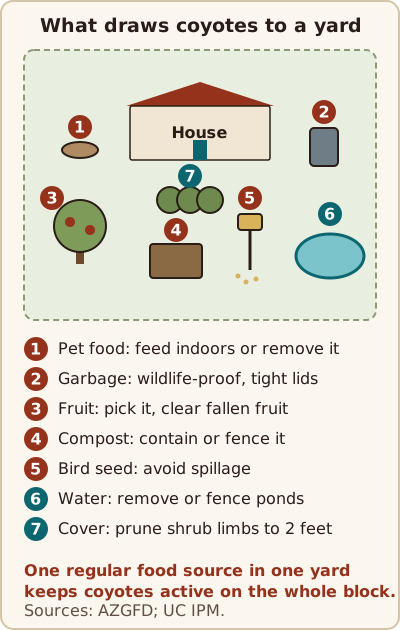
The attractants to remove
Pet food
AZGFD says to feed pets inside or remove uneaten pet food between feedings. UC IPM says cats and dogs should be fed indoors, or if fed outdoors, the dishes should be promptly emptied and removed after pets eat, and pet food should be stored indoors or in sealed heavy-duty containers.
Garbage
AZGFD says to store garbage inside or in wildlife-proof containers and to place trash containers outside at the last possible time on the day of pickup. UC IPM says to use refuse containers with tight-fitting lids so raccoons, dogs or coyotes cannot get to household garbage. UC ANR says to cover trash and compost.
Fruit, garden produce and compost
UC IPM says coyotes are attracted to ripening fruits of many kinds and will readily eat the fruits of some plants commonly used in landscaping. It advises avoiding landscape plants that produce fruits and seeds where practical and picking fruit from trees before it falls. UC ANR says to harvest ripe and fallen fruit. UC IPM also advises installing quality fencing around garden plots, because coyotes eat many common garden fruits and vegetables, and managing compost piles carefully so they do not attract rodents and other prey; compost should be fenced or contained.
Arizona yards often have dates, citrus and other fruit trees. AZGFD names dates and other fruit among foods coyotes eat. We have no Arizona page that lists specific local plants, so we do not name them as risks beyond what AZGFD says.
Bird seed and rodents
UC IPM says to manage bird feeders carefully to avoid spillage that attracts rodents and rabbits, which are attractive coyote prey. Rodents also feed coyotes: AZGFD lists them among foods. Note that feeding birds is excepted under the Arizona statute, but the seed can still bring other animals.
Water
UC IPM says to eliminate available water sources for coyotes and other wildlife, for example by removing ponds or fountains, or installing net wire fences around their perimeter. In an Arizona yard that may mean covering or fencing a decorative pond or fountain. We found no agency page that says how much coyotes depend on yard water, so we do not exaggerate its role.
Feral cats and wildlife feeding
UC IPM says not to feed feral cats, because food put out for them can also feed coyotes, and the cats can fall prey to coyote attacks. Do not put out food for any wildlife.
The rule: feeding wildlife in Arizona
AZGFD says it is unlawful to feed wildlife, except birds and tree squirrels, in Maricopa, Pinal and Pima counties under Arizona Revised Statutes 13-2927, and that some cities and counties have their own ordinances. Checked on 2026-11-14: the statute text says a person commits unlawful feeding of wildlife by intentionally, knowingly or recklessly feeding, attracting or otherwise enticing wildlife into an area, and classifies the offense as a petty offense. It excepts people lawfully taking or holding wildlife, public employees and authorized agents acting within their authority, normal agricultural or livestock operations, and the feeding of tree squirrels or birds.
We give no fine amount because we could not confirm a current one from the statute page. Read the statute at azleg.gov and confirm with AZGFD. We are not lawyers and do not offer legal advice.
Indifference counts
AZGFD says an indifferent attitude toward a coyote in your yard has the same effect as feeding it. If you see a coyote in your yard, make the animal aware it is not welcome. The agency methods are loud noise and acting large and threatening, described on our page on safe deterrence techniques. If a coyote looks sick or shows no fear of people, do not approach or touch it; keep your distance and report it to AZGFD.
Check Your Own Yard
Walk your property with the yard attractant audit. It lists each attractant from this page, such as pet food, garbage, fallen fruit, bird seed, standing water and cover, and shows what to fix first. It runs in your browser and saves nothing. Our coyote-proof yard checklist covers fencing and layout.
Beyond food and water: cover
Coyotes also use thick vegetation. UC IPM says to prune the lower limbs of shrubs and small trees to a height of 2 feet, and to clear or thin thick vegetation and remove brush and dense weeds. AZGFD says to trim back plants and bushes around the house to prevent hiding or resting places. These points are in the yard checklist.
If a coyote is already comfortable near your home
Report it. AZGFD and local animal control can advise on a coyote that has lost its fear of people, and our file a sighting report and local authorities pages explain who to call. If a pet has been attacked, see how to respond to a pet attack.
What AZGFD says coyotes eat and where they live
AZGFD calls coyotes opportunistic omnivores that eat rabbits, rodents, birds, snakes, insects, fish, fruit and carrion, and in cities also garbage and ornamental fruit. It says coyotes are usually timid, but that risk rises when they are fed or met with indifference, and that human-fed coyotes have on rare occasions bitten people. Its April 2023 release says feeding makes coyotes, javelinas, bobcats, bears and mountain lions lose their fear of people, which leads to conflict, and that removing an animal does not help if the attractants remain. (AZGFD, Living with Coyotes and April 7, 2023 release, accessed 2026-11-14.)
What we could not source
This page relies on AZGFD’s current Living with Coyotes page and April 2023 news release (both accessed 2026-11-14), the current Arizona statute and UC extension guidance. We could not source Arizona-specific plant lists, trash-can product recommendations or a measured effect of water removal. See our editorial policy.
Frequently asked questions
What attracts coyotes to a yard?
Food, water and cover. AZGFD lists coyote foods as including seeds, dates and other fruit, dead animals, rodents, rabbits, garbage, pet food, house cats and small dogs. UC IPM adds that lush landscaping provides food, water and shelter, and that bird feeder spillage attracts rodents and rabbits that coyotes prey on. Removing these draws is the first step.
Is it illegal to feed coyotes in Arizona?
In Maricopa, Pinal and Pima counties, yes. AZGFD says it is unlawful to feed wildlife, except birds and tree squirrels, under Arizona Revised Statutes 13-2927, and that some cities and counties have their own ordinances. Checked on 2026-11-14. Confirm with AZGFD.
Do I really have to stop leaving pet food outside?
AZGFD says to feed pets inside or remove uneaten pet food between feedings, and lists pet food among foods coyotes eat. UC IPM says to feed pets indoors, or promptly empty and remove dishes if fed outdoors, and to store pet food indoors or in sealed heavy-duty containers. Pet food left outside is a food source, even when you do not intend it as one.
Does standing water attract coyotes?
UC IPM says to eliminate available water sources for coyotes and other wildlife, giving removing ponds or fountains, or installing net wire fences around their perimeter, as examples. We found no Arizona agency page that quantifies how much coyotes rely on yard water, so we do not claim a figure. Removing or fencing unneeded water is a low-cost step.
Is ignoring a coyote in my yard harmless?
AZGFD says an indifferent attitude toward a coyote in your yard has the same effect as feeding it, because coyotes lose their natural fear when residents ignore them. Make the animal aware it is not welcome with noise and by acting large, never approach it. If it looks sick or shows no fear of people, do not approach or touch it; keep your distance and report it to AZGFD.
Should I feed stray or feral cats outdoors?
The UC IPM Pest Note on coyotes says not to feed feral cats, because food put out for them can also feed coyotes, and the cats can fall prey to coyote attacks. AZGFD lists house cats among animals coyotes eat. If you are concerned about stray cats in your area, contact local animal control rather than leaving food out. We found no Arizona agency page with a specific program for community cats.
Sources
- Arizona Game and Fish Department, Living with Coyotes (accessed 2026-11-14) (azgfd.com)
- Arizona Game and Fish Department, TIPS to avoid conflicts with coyotes, April 7, 2023 (accessed 2026-11-14) (azgfd.com)
- Arizona Revised Statutes 13-2927, unlawful feeding of wildlife (azleg.gov)
- UC IPM Pest Notes: Coyotes (ipm.ucanr.edu)
- Arizona Game and Fish Department, Living with Coyotes brochure (2015) (s3.amazonaws.com)
- UC ANR Coyote Cacher, Living with Urban Coyotes (trash, compost and fallen fruit) (ucanr.edu)
Related guides
- Manage and Protect Arizona Homes from Urban Coyotes
A sourced guide to making an Arizona yard less attractive to urban coyotes: food and water, fencing, pets, hazing basics and who to call in Pima County.
- Coyote Fencing for Arizona Yards
What AZGFD and UC IPM say about fencing against coyotes: height, buried bottoms, tops that deny a grip, gates, and local-rule cautions for Arizona yards.
- Coyote-Proof Yard Checklist
A sourced checklist to make an Arizona yard less attractive to coyotes: food, trash, water, cover, fencing and pets, from AZGFD and UC guidance.