Rabies and Coyotes: What the CDC Says
By CoyoteBytes Editorial TeamChecked by CoyoteBytes Editorial TeamReview date First published Filed under Encounters & Reporting
Coyotes can carry rabies, but the Arizona Department of Health Services says rabies in Arizona is found mainly in bats, skunks and foxes, and coyotes are only sometimes infected. CDC says to keep your distance from wildlife and keep pets vaccinated. After any bite or scratch, or any pet contact with a wild animal, call a doctor or vet and local animal control.
Part of our guide: What to Do If You See a Coyote
This is general information, not veterinary, medical or legal advice. For an injured or aggressive animal, a bite, a pet attack or a suspected rabies exposure, call your doctor, your vet, local animal control, or the Arizona Game and Fish Department (AZGFD).
Reviewed by the editorial desk against the cited sources. The desk holds no medical or veterinary credential; this page repeats CDC and Arizona Department of Health Services (AZDHS) wording and tells you who to call.
Rabies is the health question people most often ask about coyotes. This page belongs with our guide to how to respond to a coyote and our cluster on protecting pets and children from coyotes. The rule is simple: after any bite or scratch, or any contact between your pet and a wild animal, call a doctor or vet, and call local animal control.
The most important rule
If a coyote, or any wild animal, has bitten or scratched a person, wash the wound and call a doctor. If a pet has had any contact with a wild animal, call your vet and local animal control. Do not wait to see whether symptoms appear. AZDHS says rabies is preventable but always fatal once symptoms appear, and CDC says that you must get medical help right away.
What rabies is and how it spreads
AZDHS says rabies is a virus that attacks the central nervous system, that infection is preventable, and that it is always fatal once symptoms appear. It says all mammals, including humans, are susceptible. AZDHS says rabies is spread by contact with the saliva of an infected animal, usually through a bite wound, and that brain tissue can also be infectious and should not be handled.
CDC says rabies spreads mainly through the bites and scratches of an infected animal, and can spread to people and pets that way. CDC says bats, raccoons, skunks and foxes are the animals most often found with rabies in the U.S., and that more than 90% of reported cases of rabies in animals occur in wildlife.
Coyotes and rabies in Arizona
AZDHS says the principal rabies hosts in Arizona are bats, skunks and foxes, each carrying its own virus variant. When rabies activity in these animals increases, it can “spill over” into other mammals, such as bobcats, coyotes, javelinas, cats and dogs. Its quick-tips sheet says coyotes, bobcats, javelinas and domestic animals such as dogs, cats and horses can sometimes become infected with rabies if a rabid wild animal bites them.
On numbers, AZDHS says that from 2006 to 2017, 12 coyotes were confirmed with rabies in Arizona, and that those coyotes that were typed were all infected with the Arizona gray fox variant. We found no newer count in a page we opened, so we do not give one. Check AZDHS for current figures.
Put plainly: coyotes can be rabid, but a rabid coyote is uncommon. That is not a reason to take a bite lightly, because a bite from any wild animal should be treated as a possible exposure.
Warning signs
AZDHS says the first sign of rabies in an animal is usually a change in behavior. It says nocturnal animals might be active during the day, stagger when walking, act more aggressive or appear weak, paralyzed or agitated, and that if a wild animal is acting strangely or does not run away when you approach, it might be sick or injured. AZDHS says: do not try to help or touch the animal, stay away and call your local animal control office.
CDC says the same in plainer terms: do not approach wild animals, especially those that appear injured, sick or dead, or that are out during the day when they are normally nocturnal, and call animal control instead. Because unusual behavior can also come from other illnesses or injury, only a professional can say what is wrong. Do not try to diagnose a coyote yourself.
If a coyote looks unwell, do not haze it. Keep your distance and call. Our page on the hazing guide lists the other cases where you should not haze.
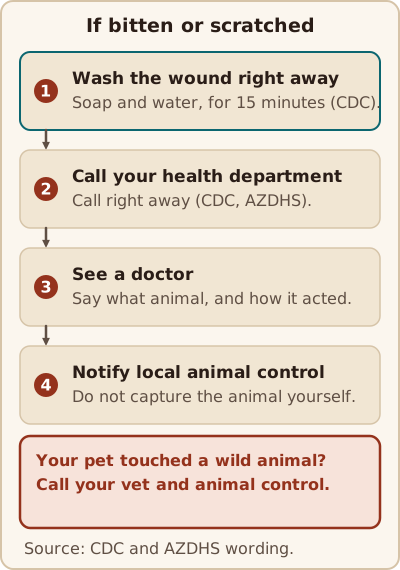
If you are bitten or scratched
Follow CDC and AZDHS wording:
- Wash the wound right away with soap and water. CDC says to wash for 15 minutes.
- Contact your health department immediately (CDC) and report the bite to your local health department (AZDHS).
- See a doctor. AZDHS says to visit your doctor and discuss anti-rabies treatment. CDC says to tell the healthcare provider what type of animal was involved and whether it seemed to be acting abnormally.
- Notify local animal control. AZDHS says to notify local animal control to capture the animal for rabies testing. Do not try to capture a wild animal yourself.
CDC says post-exposure prophylaxis, or PEP, includes wound washing, human rabies immune globulin and a series of rabies vaccines, and that it is most effective when started as soon as possible after exposure. Your doctor and health department decide whether you need it. CDC says if you are unsure whether you had direct contact with a rabid animal, consult your health department.
If the person bitten is a child, see our children and coyotes safety guide.
If your pet has contact with a coyote
Call your veterinarian and local animal control, and tell them a wild animal was involved. CDC says to treat any contact with wildlife as a concern and that pet owners can lower their risk by keeping pets up to date on rabies vaccines and keeping pets away from wild animals. AZDHS says to vaccinate all dogs and cats against rabies, to wear gloves if you handle your pet after a fight with a wild animal, and not to try to separate two fighting animals.
AZDHS also says dog owners are required by Arizona Revised Statutes (Title 11, Chapter 7, Article 6, section 11-1010) to have their dogs vaccinated against rabies and licensed, and that it is strongly recommended for cats, because cats are more likely to roam and hunt and be exposed to wildlife. Checked on 2026-11-14; confirm current requirements with your county and vet.
We do not give a protocol for exposed pets. A vet can tell you what applies to your animal. The AZDHS manual gives a booster instruction only for ferrets, so we do not extend it to other pets. For a full walk-through of an attack, read emergency steps if your pet is attacked.
Preventing exposure
- Keep your distance from wildlife (CDC), and do not feed or touch wild or unfamiliar animals (AZDHS).
- Keep pets vaccinated and away from wild animals (CDC, AZDHS).
- Do not try to rescue young wild animals (AZDHS says not to “rescue” abandoned young wild animals).
- Remove food and water that draw coyotes to your yard: see removing food and water attractants and the coyote-proof yard checklist.
Who to call
For a person bitten or scratched: your doctor and your health department. For a pet: your vet. For a coyote that looks sick or behaves aggressively: local animal control and AZGFD. In an immediate emergency, call 911. AZGFD’s 24-hour Communications Center for wildlife acting aggressively toward people is 623-236-7201; Pima Animal Care Center dispatch is 520-724-5900 ext. 4 (pima.gov, confirm before relying on it). Our local authorities page lists contacts we have verified, and report a coyote encounter explains how to report.
What AZGFD adds
AZGFD says coyotes are usually timid and run if challenged. If anyone is bitten by a coyote, call 911 and seek medical care immediately, and report it to AZGFD (24-hour line 623-236-7201). AZGFD’s April 2023 release notes 24 coyote attacks on people in the Phoenix metro area over 26 years. That is a count of attacks, not of rabies cases. (AZGFD, accessed 2026-11-14.)
What we could not source
We could not find, in a page we opened, a current Arizona count of rabid coyotes after 2017, a list of signs specific to coyotes beyond AZDHS’s general animal signs, or a vaccination schedule for pets exposed to coyotes. We leave those out. For medical questions, ask your doctor. See our editorial policy.
Frequently asked questions
Do coyotes carry rabies?
They can. The Arizona Department of Health Services (AZDHS) says rabies in Arizona is found mainly in bats, skunks and foxes, and that coyotes, bobcats, javelinas and domestic animals can sometimes become infected if a rabid wild animal bites them. AZDHS reports 12 coyotes confirmed with rabies in Arizona from 2006 to 2017.
How do I know if a coyote might have rabies?
You cannot tell from a distance, and you should not try. AZDHS says the first sign of rabies is usually a change in behavior: nocturnal animals active in the day, staggering, acting more aggressive, or appearing weak, paralyzed or agitated. An animal that acts strangely or does not run away may be sick or injured. Do not touch it; stay away and call local animal control.
What should I do if a coyote bites or scratches me?
CDC says to wash the wound right away with soap and water for 15 minutes and contact your health department immediately. Tell your healthcare provider what animal was involved and whether it acted abnormally. AZDHS says to report the bite to your local health department, visit your doctor and discuss anti-rabies treatment, and notify local animal control. Do not wait for symptoms.
What if my pet fought with or was bitten by a coyote?
Call your veterinarian and local animal control, and tell the vet a wild animal was involved. AZDHS says to keep pets away from wild animals, vaccinate all dogs and cats against rabies, and wear gloves if you handle your pet after a fight with a wild animal. CDC says to treat contact with wildlife as a concern. Your vet will advise on your pet's vaccination status.
Can rabies be treated after exposure?
CDC says post-exposure prophylaxis (PEP), which includes wound washing, human rabies immune globulin and rabies vaccine, is most effective when started as soon as possible after exposure. It also says that anyone who needs the vaccine but does not get it before symptoms begin will most likely die. That is why you should call a doctor after any bite or scratch, even if the wound looks small.
How can I lower my family's risk?
CDC says to keep your distance from wildlife, avoid animals that appear sick, injured or dead, keep pets up to date on rabies vaccines and keep pets away from wild animals as much as possible. AZDHS adds not to feed or touch wild or unfamiliar animals, and not to try to separate fighting animals. Remove food that attracts coyotes to your yard, and supervise pets and young children.
Sources
- CDC, Preventing Rabies (cdc.gov)
- CDC, About Rabies (cdc.gov)
- Arizona Department of Health Services, Manual for Rabies Control and Bite Management (including the Rabies Quick Tips sheet, January 2018) (azdhs.gov)
- Arizona Game and Fish Department, Living with Coyotes (accessed 2026-11-14) (azgfd.com)
- Arizona Game and Fish Department, TIPS to avoid conflicts with coyotes, April 7, 2023 (accessed 2026-11-14) (azgfd.com)
Related guides
- Coyote Hazing Methods Agencies Recommend
How AZGFD describes scaring a coyote: noise, looking large, eye contact, backing toward people. Plus when NOT to haze: sick, cornered or denning coyotes.
- Coyote Aggressive Behavior: Warning Signs
Warning signs of bold or aggressive coyote behavior in Arizona, what the agencies say causes it, and the calm steps to take and who to call.
- Coyote Encounter Checklist
A coyote encounter checklist for Arizona residents: steps for a coyote nearby, following you, near your pet, at your door or sick, plus who to call.
- Mange and Sick-Looking Coyotes: Who to Call
A coyote that looks sick or mangy in Arizona: keep your distance, do not feed or approach it, and know when to call AZGFD, animal control or a doctor.
- What to Do if You Encounter a Coyote, by Situation
Steps for each coyote encounter: at a distance, following you, near your dog, in your yard, sick or near a den, plus who to call and what not to do.
- What to Do If You See a Coyote
What agencies and extension sources say to do when you see a coyote: hazing basics, when to keep your distance and call, and what to do after a bite.