Coyote Hazing Methods Agencies Recommend
By CoyoteBytes Editorial TeamChecked by CoyoteBytes Editorial TeamReview date First published Filed under Encounters & Reporting
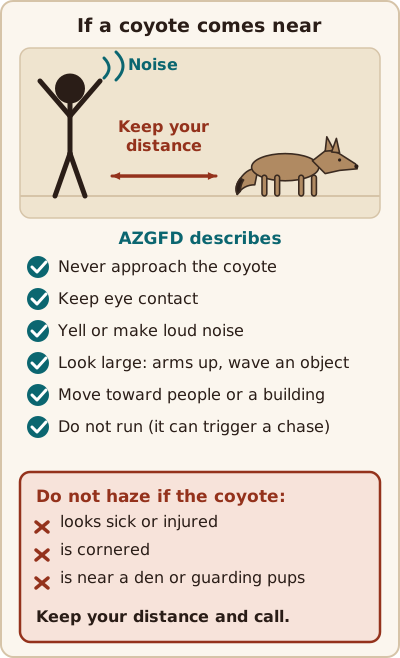
Hazing means making a coyote feel unwelcome so it keeps its fear of people. The Arizona Game and Fish Department (AZGFD) describes it as never approaching the coyote, keeping eye contact, yelling or making loud noise, and looking large with aggressive gestures while moving toward people or a building. Never haze a coyote that looks sick, is cornered or may be protecting a den or pups.
Part of our guide: What to Do If You See a Coyote
This is general information, not veterinary, medical or legal advice. For an injured or aggressive animal, a bite, a pet attack or a suspected rabies exposure, call your doctor, your vet, local animal control, or the Arizona Game and Fish Department (AZGFD).
Reviewed by the editorial desk against the cited sources. The desk holds no wildlife-biology, veterinary or medical credential.
Hazing is part of our guide to what to do if you see a coyote, and it also supports protecting pets and children from coyotes. This page describes only what the agencies describe: noise, looking large and backing toward people. It does not describe weapons, projectiles, sprays, chasing or any way of harming a coyote, and it tells you clearly when not to haze at all.
What hazing is for
AZGFD says coyotes are usually timid animals that run away if challenged, but that they can become a risk once they are comfortable around humans, usually through feeding or indifference. The agency says residents must aggressively discourage coyotes from feeling comfortable, including by using aggressive gestures toward coyotes when they are seen, and that an indifferent attitude toward a coyote in your yard has the same effect as feeding it. Hazing is how residents make a coyote aware it is not welcome.
The goal is distance, not injury. A coyote that learns people are not safe to approach keeps its natural fear. That is only half of the job: remove the food, water and cover that bring coyotes in, using the yard checklist and attractant guide.
Before you do anything: the “do not haze” cases
Never haze, and do not approach, a coyote in any of these situations. Keep your distance and call AZGFD or local animal control:
- The coyote looks sick or injured. Signs the agencies list include acting strangely, not running away when approached, staggering, appearing weak or agitated, or being active in the day when it is normally nocturnal. CDC says not to approach wild animals that appear injured or sick, or that are out during the day when they are normally nocturnal. AZDHS says do not try to help or touch the animal, stay away and call local animal control. UC ANR says never to approach an aggressive, sick or injured coyote unless trained to do so.
- The coyote is cornered. Hazing is meant to let the animal leave. If it has no escape route you are not leaving it a way out, and an animal with no escape can act unpredictably. UC ANR says coyotes can be unpredictable and defensive. The agency pages we opened do not give a rule specifically for cornered coyotes, so this is our cautious reading of that advice.
- You think there is a den nearby, or the coyote seems to be protecting pups. AZGFD says coyotes raise pups in a den, and UC IPM says coyotes are more likely to attack dogs during pup-rearing season if dogs come too near a den site. Do not approach the den. Keep pets and children away and call AZGFD. We do not describe any method for moving a den or pups.
- You are with a small child or small pet and cannot control the situation. Protect them first; see below.
- You feel in immediate danger. UC ANR says to call 911 if you sense an immediate threat to your safety.
The methods, as the agency describes them
AZGFD’s Living with Coyotes page lists these points for what to do if a coyote approaches:
- Never approach a coyote.
- Keep eye contact. AZGFD says to show you are dominant by keeping eye contact with the animal.
- Make noise. Yell, or make loud noises with whistles, blare music, or bang on pots and pans.
- Look large and threatening. AZGFD says to act as large and threatening as possible, making aggressive gestures with your arms and legs, or by waving an object at the animal.
- Move toward other people or a building.
- Do not run. AZGFD says not to stimulate a coyote’s chase instinct by running.
- Pick up small pets.
- Protect small children so they will not panic and run.
AZGFD also says to use these deterrents while walking a dog: gather your dog in your arms or keep it as close to you as possible, let the coyote know you are there, and move toward an area of human activity.
The same AZGFD page also lists a homemade noise-and-flash device (a soft drink can with washers or pebbles, wrapped in foil and taped closed) as a visual and noise deterrent. We mention it only to show the principle: noise plus light plus gesture. We do not give instructions for it, because a loud, clear voice and your own movement do the same job without preparation.
What we leave out on purpose
AZGFD’s Living with Coyotes page and a 2007 California extension publication also mention throwing objects at a coyote, spraying with water or other liquids and, in the California note, air horns and walking sticks. We do not recommend throwing objects, spraying, striking, chasing or using any weapon or projectile. Those steps raise the risk of injury to you, to children and to the animal, and we found nothing in a page we opened that says a resident must do them. If you want agency guidance on any of them, ask AZGFD directly.
Keep it consistent, and keep it varied
UC IPM says sound and visual stimuli provide only temporary effectiveness, if any, because coyotes quickly adapt or habituate to sounds, flashing lights and scarecrows when there is no real threat. It says such efforts are likely to work best where coyotes are wary and where stimuli can be frequently varied in type and location. It also says certain hazing techniques, combined with modifications that make the environment less attractive, may reduce the chance that coyotes lose their wariness of humans when they first venture into a suburban area, and that motion-sensitive lights on houses or outbuildings may deter coyotes from approaching.
So treat hazing as one tool. Without removing food, it does little for long. We do not review or recommend commercial repellents or devices.
Hazing with children and pets
If a coyote approaches while you have young children, protect them first: keep them close, hold small children and do not let them run, as AZGFD advises, then use the loud, large-and-threatening methods above while moving toward people or a building. Do not ask a child to haze a coyote. See our children and coyotes safety guide.
For pets, AZGFD says pets most likely to be endangered are typically off-leash or smaller than 25 pounds. Pick up small pets, keep dogs close and leave the area. If your pet is attacked, veterinary attention comes first: see what to do if a coyote attacks your pet.
After the coyote leaves
Report coyotes that approach people, behave boldly or seem sick. Our local authorities and report a coyote encounter pages explain how. If anyone was bitten or scratched, wash the wound and call a doctor; see coyote rabies facts.
Rules
Checked on 2026-11-14. AZGFD says it does not respond to calls to relocate or remove coyotes unless there is a public-safety concern, and that lethal removal is a last resort. Hazing as described here does not touch, capture or kill the animal. Feeding wildlife is unlawful in Maricopa, Pinal and Pima counties (A.R.S. 13-2927), and feeding is what teaches coyotes to lose their fear. Confirm any rule with AZGFD. If a coyote approaches or has bitten a person, call 911; AZGFD’s 24-hour Communications Center for aggressive wildlife is 623-236-7201.
If someone is bitten or a coyote will not leave
AZGFD says that if a coyote attacks a person you should report it to AZGFD or call 911, and that anyone bitten should seek medical care immediately. For wildlife acting aggressively toward people, AZGFD’s 24-hour Communications Center is 623-236-7201 (AZGFD, accessed 2026-11-14). Hazing is not a substitute for those calls. AZGFD lists further deterrents on its page that we do not instruct here; this guide keeps to noise, standing tall, eye contact, not running and moving toward people.
What we could not source
This page relies on AZGFD’s current Living with Coyotes page and April 2023 news release (accessed 2026-11-14), UC extension pages, CDC and AZDHS. We could not find an agency rule specific to cornered or denning coyotes, so those cautions are our own. See our editorial policy.
Frequently asked questions
What is hazing a coyote?
Hazing means making a coyote feel unwelcome so it keeps its natural fear of people. AZGFD says coyotes become risky once they are comfortable around humans, and that residents should use aggressive gestures toward coyotes and make the animal aware it is not welcome. The methods the agency describes are noise and looking large and threatening. They never involve touching, chasing or harming the animal.
What are the agency-recommended hazing methods?
AZGFD says never to approach the coyote, to keep eye contact, and to yell or make loud noises with whistles, music or banging pots and pans. It also says to act as large and threatening as possible with aggressive gestures of your arms and legs or by waving an object, and to move toward people or a building. Do not run.
When should I not haze a coyote?
Do not haze a coyote that looks sick or injured, is cornered, is near a den, or appears to be protecting pups. Keep your distance and call AZGFD or animal control. UC ANR says never to approach an aggressive, sick or injured coyote unless trained, and CDC and AZDHS say to stay away from wild animals that seem sick or act strangely.
Should I run from a coyote?
No. AZGFD says not to stimulate a coyote's chase instinct by running. Keep eye contact, make noise, look large and move toward an area with other people or a building. If you have a small pet, pick it up. If you have a small child, protect the child so they do not panic and run. If anyone's safety is under immediate threat, call 911.
Does hazing work forever?
Not by itself. UC IPM says sound and visual stimuli provide only temporary effectiveness, if any, because coyotes quickly adapt to them when there is no real threat. It says certain hazing techniques, combined with modifications that make the environment less attractive, may help when coyotes first venture into an area and are still wary. Remove food and cover as well.
Can I use weapons, projectiles or sprays?
No. This page does not recommend weapons, projectiles, sprays or any harm to a coyote. AZGFD's page lists further deterrents beyond noise and body language; this guide focuses on noise and distance because those carry the least risk to you, children and the animal. AZGFD says it does not relocate or remove coyotes except for public-safety threats. Confirm any rule with AZGFD, and call the agency.
Sources
- Arizona Game and Fish Department, Living with Coyotes (accessed 2026-11-14) (azgfd.com)
- Arizona Game and Fish Department, TIPS to avoid conflicts with coyotes, April 7, 2023 (accessed 2026-11-14) (azgfd.com)
- UC IPM Pest Notes: Coyotes (ipm.ucanr.edu)
- UC ANR Coyote Cacher, Living with Urban Coyotes (ucanr.edu)
- CDC, Preventing Rabies (cdc.gov)
- Arizona Department of Health Services, Manual for Rabies Control and Bite Management (azdhs.gov)
Related guides
- Rabies and Coyotes: What the CDC Says
Rabies and coyotes in Arizona, using CDC and Arizona DHS wording: how it spreads, warning signs, and what to do after any bite, scratch or pet contact.
- Coyote Aggressive Behavior: Warning Signs
Warning signs of bold or aggressive coyote behavior in Arizona, what the agencies say causes it, and the calm steps to take and who to call.
- Coyote Encounter Checklist
A coyote encounter checklist for Arizona residents: steps for a coyote nearby, following you, near your pet, at your door or sick, plus who to call.
- Mange and Sick-Looking Coyotes: Who to Call
A coyote that looks sick or mangy in Arizona: keep your distance, do not feed or approach it, and know when to call AZGFD, animal control or a doctor.
- What to Do if You Encounter a Coyote, by Situation
Steps for each coyote encounter: at a distance, following you, near your dog, in your yard, sick or near a den, plus who to call and what not to do.
- What to Do If You See a Coyote
What agencies and extension sources say to do when you see a coyote: hazing basics, when to keep your distance and call, and what to do after a bite.