Protect Pets and Children from Coyotes in Arizona
By CoyoteBytes Editorial TeamChecked by CoyoteBytes Editorial TeamReview date First published Filed under Pets & Children
Extension sources say coyotes take advantage of pets left to roam, so supervise pets outdoors, keep small pets indoors or in enclosures, bring large dogs in after dark, and keep dogs leashed. Feed pets indoors, keep rabies vaccinations current, and if a pet has contact with a wild animal, see your vet and call Pima Animal Care Center.
This is general information, not veterinary, medical or legal advice. For an injured or aggressive animal, a bite, a pet attack or a suspected rabies exposure, call your doctor, your vet, local animal control, or the Arizona Game and Fish Department (AZGFD).
Reviewed by the editorial desk against the cited sources. The desk holds no wildlife-biology, veterinary or medical credential; see our editorial policy.
The sources we could open agree on one point for pets: coyotes take advantage of animals left outside unsupervised, and the safest pet is one that is indoors, in an enclosure, or supervised. This hub collects what University of Arizona Cooperative Extension, UC IPM, Pima Animal Care Center and the CDC say. For the full picture of what draws coyotes in, see Coyote Information for Arizona Homeowners; for a face-to-face sighting, see What to do during a sighting.
If a coyote has attacked or injured your pet, get veterinary attention first, then call Pima Animal Care Center at 520-724-5900, then press 4.
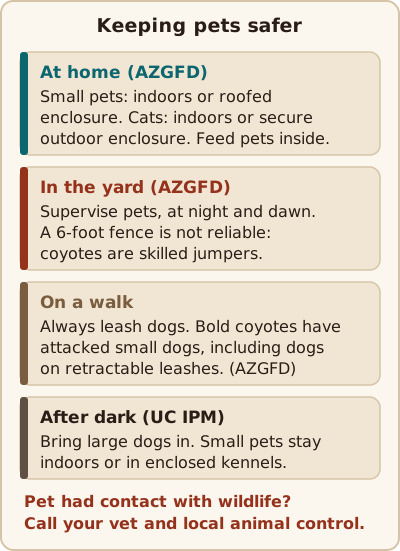
Supervise pets outdoors
University of Arizona Cooperative Extension says to supervise your pets outdoors and not let them roam freely, because they may end up as a meal for coyotes, hawks, owls, bobcats and other predators, or come into conflict with javelina and skunks. UC IPM goes further and says never to allow cats or dogs to run free at any time, as they are easy prey.
Small pets, cats and large dogs
UC IPM advises keeping small pets indoors or in enclosed kennels and bringing large dogs in after dark. Pima County’s health department says to keep cats and ferrets indoors and to supervise dogs.
Walking a dog
UC IPM advises keeping dogs on a leash in busy areas, avoiding dawn and dusk walks, and varying your routine. AZGFD’s August 2025 bulletin asks residents to keep dogs leashed and to supervise pets outdoors, especially where wildlife is present. If you meet a coyote on a walk, follow the steps in the encounter guide, and do not let your dog approach it.
Feeding and yard habits that protect pets
Feed pets indoors, or remove leftover pet food from outdoors at once, and store pet food securely, say extension sources. Pet food outside attracts coyotes and other wildlife that then come close to your pets. See the yard and home guide for the full list.
Vaccinations
The CDC says to keep pets up to date on rabies vaccines and away from wild animals as much as possible. Pima County says to vaccinate pets, including indoor cats, and says current dog vaccinations are required by law. AZGFD’s bulletin also says to make sure pets are fully vaccinated and to ask your veterinarian about canine distemper, which affects canids and is dangerous to unvaccinated dogs.
If your pet has contact with a wild animal
Pima Animal Care Center’s March 2021 release says to take your animal to the vet for a rabies booster and to call Animal Protection at 520-724-5900, option 4. The same release described a 45-day home quarantine for pets with a prior rabies vaccination and 120 days of shelter observation for pets never vaccinated; those are 2021 figures, so confirm the current rules with Pima Animal Care Center. See Who to Call.
Children
We could not find a dedicated child-safety page from AZGFD that we were able to open, so this section is limited to what we did open. Pima County’s health department says to teach children never to handle unfamiliar animals, wild or domestic, even if they seem friendly, and to stay away from wild animals that are injured or acting odd. University of Arizona Cooperative Extension says attacks on people usually occur when animals associate people with food, which is another reason to keep food out of reach. Check the AZGFD living with coyotes page for AZGFD’s current guidance on children.
If a person is bitten or scratched
Wash the wound with soap and water and seek medical care urgently, says the CDC. Tell your provider what animal was involved and whether it was acting abnormally.
What AZGFD says about pets and coyotes
AZGFD says coyotes are usually timid but that bold coyotes have attacked small dogs, including dogs on retractable leashes (AZGFD, Living with Coyotes, accessed 2026-11-14). Its pet advice, in short:
- Keep small pets indoors or in a roofed enclosure, and supervise pets at night and dawn.
- Always keep dogs leashed.
- Do not count on a fence: AZGFD says a 6-foot fence is not reliable protection because coyotes are skilled jumpers.
- Keep domestic birds such as chickens, ducks and turkeys in a sturdy, roofed enclosure, and do not spread seed on the ground, which attracts prey and so coyotes.
- Feed pets inside, and remove pet food, water bowls, bird feeders and fallen fruit from the yard.
Attractants that put pets at risk
AZGFD lists unattended pets themselves, with pet food, garbage and fallen fruit, as food sources, and pet bowls, fountains and pools as water sources. It also says shrubs, storm drains and spaces under sheds and porches give coyotes shelter (AZGFD). Trimming ground-level shrubs, securing garbage (put out on the morning of pickup) and using motion-activated lights, sprinklers or noise are on AZGFD’s prevention list, as is working with neighbors.
Mating and denning season
AZGFD says coyotes mate from January to March and raise 4 to 7 pups in a den from March to May (AZGFD). A coyote with a den nearby may be more protective, so keep dogs leashed and away from dens and brush, and do not haze it.
If a coyote approaches while you are with a pet or child
AZGFD’s encounter steps include never approaching a coyote, keeping eye contact, not turning and running, leashing pets, picking up small pets and children, and moving toward people, buildings or activity. It also lists loud noises as a way to scare a coyote off (AZGFD). AZGFD lists further deterrents too; this guide focuses on noise and distance. See What to Do If You See a Coyote.
Feeding is unlawful
Feeding wildlife (except birds and tree squirrels) is unlawful in Maricopa, Pinal and Pima counties under A.R.S. 13-2927, according to AZGFD’s April 2023 tips release; some cities and counties have their own ordinances, so check local rules and confirm with AZGFD (checked on 2026-11-14).
If a coyote attacks a person
If a coyote is approaching or has bitten a person, call 911 and seek medical care immediately for any bite; AZGFD’s 24-hour Communications Center for wildlife acting aggressively toward people is 623-236-7201 (AZGFD tips release).
All Pets And Children guides
- Coyote Seasons and Pet Safety: What the Sources Say
Coyote activity through the year and what to do for your pets each season, from AZGFD mating and pup dates to dawn, dusk and denning advice.
- Keeping Small Dogs Safe from Coyotes
What AZGFD and extension sources say about protecting small dogs from coyotes, from supervision and leashes to yards, enclosures and encounters.
- Outdoor Cats and Coyotes in Arizona
What AZGFD and extension sources say about coyotes and outdoor cats, why they advise indoor living or a secure enclosure, and what to do if a cat is hurt.
- Walking Your Dog Where Coyotes Live
What AZGFD and extension sources advise for dog walks in coyote country, from leashes and off-leash rules to meeting a coyote and calling for help.
Frequently asked questions
Should I let my small dog or cat outside alone in Arizona?
The extension sources say no. University of Arizona Cooperative Extension says to supervise pets outdoors and not let them roam. UC IPM advises keeping small pets indoors or in enclosed kennels and says never to let cats or dogs run free, as they are easy prey. Pima County recommends keeping cats and ferrets indoors.
Is it safe to walk my dog at dawn and dusk?
UC IPM advises keeping dogs on a leash in busy areas, avoiding dawn and dusk walks, and varying your routine. This is a California extension recommendation. AZGFD's 2025 bulletin asks residents to keep dogs leashed and to supervise pets outdoors, especially where wildlife is present. If you see a coyote, keep your dog close and leave.
What should I do if my pet has contact with a coyote?
Pima Animal Care Center's 2021 release says to take your animal to the vet for a rabies booster and to call Animal Protection at 520-724-5900, option 4. Get veterinary attention first for any injury. Rules for observation or quarantine depend on the pet's vaccination status, so confirm the current rules when you call.
Do my pets need rabies and distemper vaccinations?
The CDC says to keep pets current on rabies vaccines, which greatly lowers their risk and yours. Pima County says current dog vaccinations are required by law and recommends vaccinating even indoor cats. AZGFD's August 2025 bulletin says to make sure pets are fully vaccinated and to ask your veterinarian about canine distemper.
How do I keep my children safe around coyotes?
The sources we could open say little that is child-specific. Pima County says to teach children never to handle unfamiliar animals, wild or domestic, even if they seem friendly, and to stay away from wild animals that are injured or acting odd. University of Arizona Cooperative Extension says to keep food away from wildlife. Check AZGFD for current child guidance.
What if a coyote or other wild animal bites or scratches someone?
The CDC says to wash the wound with soap and water and get medical care urgently, because rabies treatment works best when started soon. Tell your provider what animal was involved and whether it was acting abnormally. Do not wait to see whether symptoms appear. Also contact local animal control so the animal can be assessed.
Sources
- University of Arizona Cooperative Extension: Potential Wildlife Conflicts (AZ1481c) (extension.arizona.edu)
- UC IPM Pest Notes: Coyote (UC ANR Publication 74135, updated March 2007) (ipm.ucanr.edu)
- AZGFD bulletin: AZGFD urges vigilance during canine distemper outbreak (12 Aug 2025) (content.govdelivery.com)
- CDC: About Rabies (cdc.gov)
- CDC: Rabies Prevention and Control (cdc.gov)
- Pima Animal Care Center: Wildlife making appearances around Pima County (11 Mar 2021) (oldcms.pima.gov)
- Pima County Health Department: Rabies (page marked not maintained) (oldcms.pima.gov)
- University of Arizona Cooperative Extension: Preventing Dangerous Interactions with Wildlife (AZ1481d) (extension.arizona.edu)
- Pima County: Health department reminder: Avoid rabies by staying away from wildlife (17 Mar 2022) (oldcms.pima.gov)
- Arizona Game and Fish Department: Living with Coyotes (accessed 2026-11-14) (azgfd.com)
- Arizona Game and Fish Department: TIPS to avoid conflicts with coyotes (7 Apr 2023; accessed 2026-11-14) (azgfd.com)
Related guides
- Coyote Seasons and Pet Safety: What the Sources Say
Coyote activity through the year and what to do for your pets each season, from AZGFD mating and pup dates to dawn, dusk and denning advice.
- Keeping Small Dogs Safe from Coyotes
What AZGFD and extension sources say about protecting small dogs from coyotes, from supervision and leashes to yards, enclosures and encounters.
- Outdoor Cats and Coyotes in Arizona
What AZGFD and extension sources say about coyotes and outdoor cats, why they advise indoor living or a secure enclosure, and what to do if a cat is hurt.
- Walking Your Dog Where Coyotes Live
What AZGFD and extension sources advise for dog walks in coyote country, from leashes and off-leash rules to meeting a coyote and calling for help.
- Children and Coyotes: A Safety Guide
How to keep children safe around coyotes in Arizona, from AZGFD, UC and CDC guidance: supervision, yards, if a coyote approaches, and who to call.
- Coyotes and Backyard Poultry or Livestock
What University of Arizona Extension, UC IPM, USDA and AZGFD say about protecting poultry and livestock from coyotes, and what the rules say.