Pet Safety by Season Guide
By CoyoteBytes Editorial TeamChecked by CoyoteBytes Editorial TeamReview date First published Filed under Tools
Agencies do not publish a month-by-month coyote risk calendar for Arizona, so this guide states only the patterns they do give. University of California pest notes flag pup-rearing season (March through August) and dawn and dusk walks. AZGFD and Extension flag spring den-seeking and year-round supervision. Everything else is left blank rather than guessed.
What do the sources say for my month and time?
This is general information, not veterinary, medical or legal advice. For an injured or aggressive animal, a bite, a pet attack or a suspected rabies exposure, call your doctor, your vet, local animal control, or the Arizona Game and Fish Department (AZGFD).
Only patterns a cited source states are shown. A pattern is not a safe or unsafe forecast: keep the year-round checklist in every season.
Part of our guide: Free Coyote Safety Tools
This is general information, not veterinary, medical or legal advice. For an injured or aggressive animal, a bite, a pet attack or a suspected rabies exposure, call your doctor, your vet, local animal control, or the Arizona Game and Fish Department (AZGFD).
Reviewed by the editorial desk against the cited sources. The desk holds no wildlife-biology, veterinary or medical credential; see our editorial policy. Checked on 2026-11-14.
Many people want a calendar that says when coyotes are most dangerous to pets. The agencies we are allowed to cite do not give one for Arizona, and we will not make one up. This guide lists only the timing patterns they do state, marks where the sources are silent, and gives you a printable year-round checklist. It is part of our free coyote safety tools and supports the pet and child safety guide.
How to use it
- Read the “what the sources say” table for the season you are in.
- Use the printable checklist below every season; the basics do not change.
- Where a cell says “no source,” do not assume safety. Keep the year-round steps.
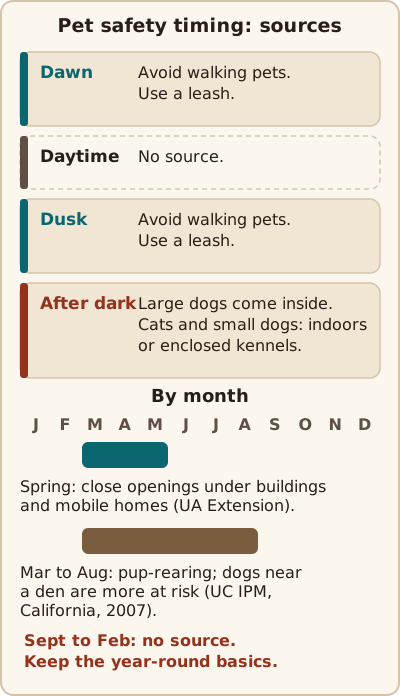
What the sources say, by season
| Season or time | What a source says | Source |
|---|---|---|
| Spring | Closing openings under buildings and mobile homes is even more critical, when many animals look for den sites | University of Arizona Extension |
| March through August | Pup-rearing season; coyotes more likely to attack dogs that come too near the den (California publication, 2007) | UC IPM |
| Dawn and dusk | Avoid walking pets at these times and use a leash | UC IPM |
| After dark | Large dogs should come inside; cats and small dogs stay indoors or in enclosed kennels | UC IPM |
| Summer | No source | None |
| Autumn | No source | None |
| Winter | No source | None |
The UC IPM notes are a California publication from 2007. We use them only for general behavior advice and have not found an Arizona agency page stating the same dates. Ask AZGFD whether they apply where you live.
Printable checklist, every season
- Supervise pets outdoors; do not let them roam freely.
- Keep pets on a leash whenever they are out of the yard.
- Keep cats and small dogs indoors or in enclosed kennels; bring large dogs in after dark.
- Avoid walking pets at dawn or dusk if you can.
- Feed pets indoors or remove leftover food immediately.
- Secure garbage and keep bird seed off the ground; see the yard attractant audit.
- Keep pets current on rabies vaccines (CDC).
- If a coyote approaches, keep your pet close and keep your distance. Do not haze a coyote that looks sick, is cornered, or may be guarding pups or a den; leave the area and call.
- After any contact between a pet and a wild animal, call your vet and local animal control.
When a coyote approaches
The UC IPM coyote notes say that if a coyote approaches you, shout in a deep voice, wave your arms and back away slowly without turning your back. AZGFD’s brochure describes making wildlife uncomfortable with loud noises. We do not describe weapons or projectiles, and we do not advise hazing an animal that looks sick or may have pups nearby.
Related
Frequently asked questions
Is there an official coyote season in Arizona?
We found no Arizona agency page we could cite that gives a coyote risk calendar. The UC IPM notes, a California publication from 2007, mention pup-rearing season as March through August. Treat that as a general guide only, and ask AZGFD whether it applies where you live. Our guide does not assign risk levels to individual months.
Is it safer to walk my dog at midday?
UC IPM advises avoiding walking pets at dawn or dusk and using a leash. It does not say midday is risk free, and we found no Arizona agency that does. A leash and close supervision are what Extension recommends year-round. If you see a coyote, keep your pet close and keep your distance.
Why are coyotes more protective in spring and summer?
UC IPM says coyotes are more likely to attack dogs during the pup-rearing season if dogs come too near the den site. It does not describe individual behavior beyond that. If a coyote seems to be guarding an area, do not haze it. Keep your distance, leave the area with your pet, and call AZGFD or animal control.
Do I need to do anything different in summer heat?
The sources we are allowed to cite do not give summer-specific coyote advice, so we make no claim. The year-round steps still apply: supervise pets, keep them leashed outside the yard, feed pets indoors and secure garbage. For heat safety for pets, ask your veterinarian.
Should cats stay indoors?
UC IPM says cats and small dogs should stay indoors or in enclosed kennels. University of Arizona Extension says pets that roam freely may end up as a meal for coyotes, hawks, owls, bobcats and other predators. Keeping cats indoors follows both. For your own pet's situation, ask your veterinarian.
What if my pet has contact with a coyote?
Call your veterinarian right away and tell local animal control about the contact with a wild animal. The CDC says to keep pets away from wild animals and keep rabies vaccinations current. Veterinary attention comes first for an injured pet. Pima County's Animal Protection Services dispatch is 520-724-5900, ext. 4; confirm before calling.
Sources
- UC IPM: Coyote Pest Notes (2007, California) (ipm.ucanr.edu)
- University of Arizona Cooperative Extension: Potential Wildlife Conflicts (AZ1481c, 2009) (extension.arizona.edu)
- AZGFD: Keep Wildlife Wild brochure (PDF) (live-azgfd-main.pantheonsite.io)
- CDC: Rabies Prevention and Control (cdc.gov)
- Pima County: Animal Protection (pima.gov)
Related guides
- Coyote Encounter Report Builder
Organize the details of a coyote sighting or encounter into a ready-to-send summary for AZGFD or Pima County, with a plain-text template to copy or print.
- Yard Attractant Audit
A printable checklist to audit your Arizona yard for food, water, garbage, pet food, cover and fencing that draw coyotes, from AZGFD and extension advice.
- Coyote Safety Flier: Printable Tips for Neighbors
A one-page printable coyote safety flier for Arizona neighbors: remove food, protect pets, supervise children, and what to do if a coyote approaches.
- Free Coyote Safety Tools
Free, printable coyote safety tools for Arizona residents: an encounter checklist, a neighborhood flier and more, each sourced to AZGFD and CDC pages.